


In Part V of our history around the coast-path, we explored the impact of the wars with France, -taxes, smuggling, and the creation of the coast path. By 1815, Britain was indisputably the victor of this world-wide rivalry with France. How was the new dawn of peace, after 70 years of war between 1688 and 1815, to play out in the south-west? To understand this, we have to back-track a little. The vast financial resources deployed by the British government, in large part to build-up the navy and army to wrest control of colonies and sea-lanes from Britain’s enemies, had created optimum conditions for trade and industry to flourish – captive markets and abundant raw materials. The fruits of all this trade and industry created a new, genteel, middle–class, so beautifully described by Jane Austin. Jane’s holidays to fashionable Lyme Regis provided the background for ‘Persuasion’.
An Age of Elegance
In Britain, the dominant 18th century agricultural component of the economy benefitted from improved techniques and guaranteed home markets. Aristocratic landowners in times of good harvests were generating huge amounts of capital to invest in canals, turnpikes, trade, and industry, and of course elegant country houses. Saltram House, (National Trust), on the River Plym is arguably the finest of these Georgian country houses in the south-west. Fabulously decorated by Robert Adam and full of treasures, it is well worth the small detour from the coast path.
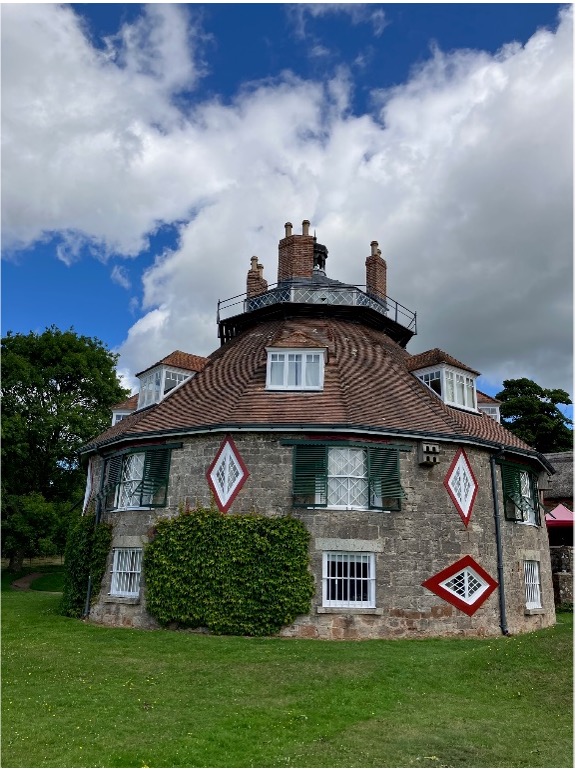
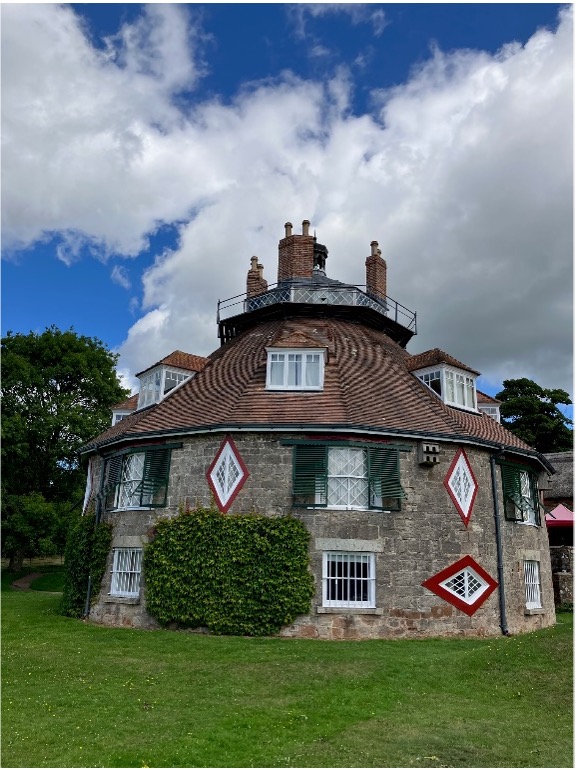
The benefit of being the prime mover of the world’s first industrial revolution created not only enormous wealth for those landowners lucky enough to own mineral rights, but also the conditions for a new middle class, sufficiently wealthy to enjoy some of the most elegant architecture ever created. What we characterise as ‘Georgian architecture’. A La Ronde, near Exmouth is an example of female patronage inspired by a ‘Grand Tour’.
Photo: ‘A La Ronde’ – a beautiful ‘gentlewoman’s’ estate near Exmouth – now National Trust
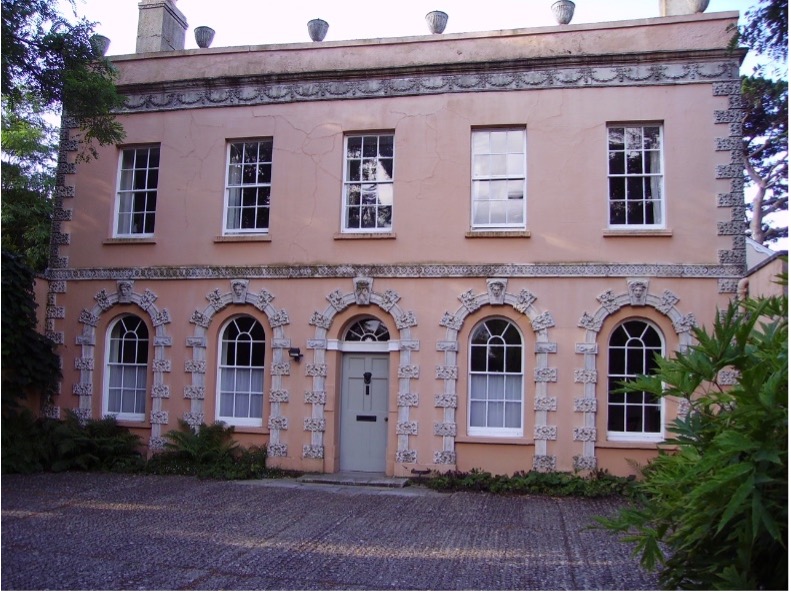
Why is it that this architecture is so satisfying? I think the overall sense of proportion, tasteful ornament, and beautifully crafted small pane, wooden, sash windows, which break-up the otherwise bland expanse of plate glass in fashion with the later Victorians – and now so ubiquitous in our own age. Successful bankers, lawyers, merchants, and their fortunate children, set up as Squires in country estates. Those who could not afford to do so moved to elegant crescents and squares.
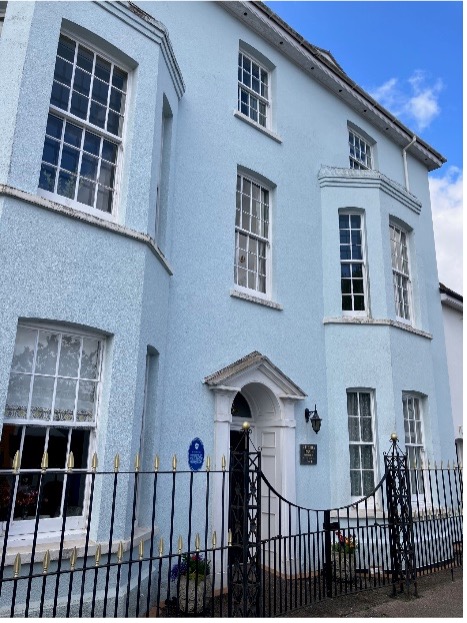
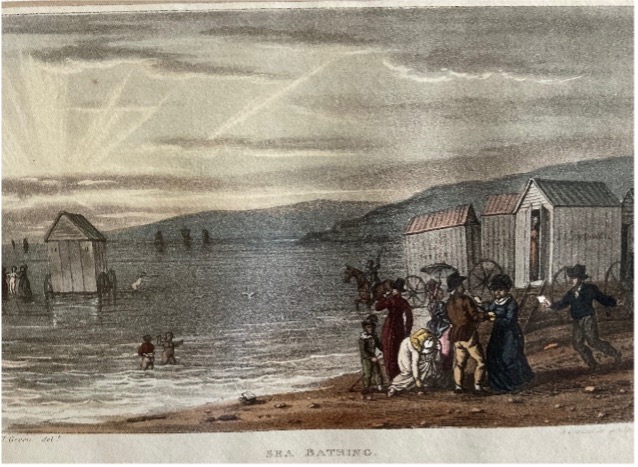
The successive periods of wars with France, removed one of the great pleasures of the aristocratic and increasingly wealthy middle-class elites – foreign travel. The British gentry discovered two new passions – the seaside and the rugged beauty of our upland countryside. The coast path close to the fashionable south-west coast Regency resorts of Weymouth, Lyme Regis, Sidmouth, Exmouth, Teignmouth and Shaldon, combined aspects of sea, and scenery which were, and in many cases still are, intoxicating.
Photo: ‘Belmont’, Lyme Regis – Holiday home of the remarkable 18th century businesswoman Mrs Eleanor Coade – now Landmark Trust
These resorts became fashionable partly because they were all accessible by fast, efficient mail coach on the network of turnpike roads but also because of the peculiarities of royal patronage. Put simply the large family of George III did not get on. Sea-bathing for health reasons became very fashionable. King George III led the fashion by patronising Weymouth. His eldest son the Prince Regent favoured Brighton. The Duke of York – Exmouth. The Duke of Kent, with the infant Princess Victoria – Sidmouth. Sidmouth, Lyme Regis, and Exmouth are arguably the least unspoilt of these regency spas.
The new fashion for ‘gentlemen’ amateur science spurred innovation, and sometimes the part that women played is forgotten. In Exmouth we can still find the holiday home of the mathematician Ada Lovelace, considered one of the great pioneers of computer programming, so much so that in 1980 the US Department of Defence named its computer code, ‘ADA’, after her.
The attractions of Lyme were different. Lyme sits on the only visible and accessible coast which covers the whole Age of the Dinosaurs, 185 million years of natural history. Miss Jane Austen may have met Miss Mary Anning in the streets of Lyme. Separated by class, Mary was to become one of the greatest palaeontologists and fossil hunters Britain has ever known. Poor and self-taught, Mary had to sell her spectacular finds to survive, nevertheless Mary’s fame became such that the most eminent geologists of the age from Britain and overseas came to learn, fossil hunt with her, and buy from her collection.
Mary saved enough to open a fossil shop in 1826, helped by her discovery and sale of the first Plesiosaurus skeleton in 1823 and the first flying reptile specimen, Pterodactylus, in 1828. King Fredrick Augustus of Saxony visited her shop in 1844. The recent film ‘Ammonite’ is bringing Mary’s work to a modern audience. The characters in the film are real, the danger and difficulty of fossil hunting on these unstable cliffs well represented, but the love affair, central to the film, although great drama, is pure fiction. Today the stunning Lyme Regis Museum is a gem, built on the site of Mary Anning’s home and should be on the agenda of every visitor to Lyme and the coast path. The ‘Etches Collection museum’ further to the east at Kimmeridge, offers a fascinating insight into the late Jurassic seas, and what can still be discovered on this, Britain’s only, UNESCO Natural World Heritage Coastline.
The Industrial Revolution – Innovation, the Engine of Georgian Prosperity
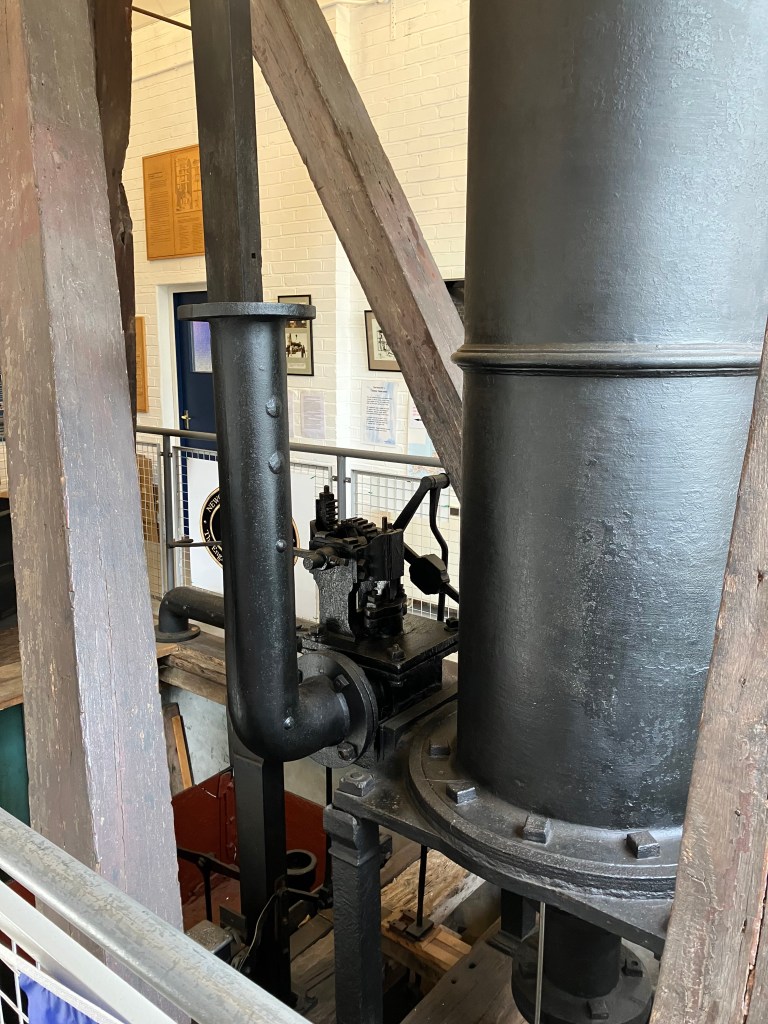
The war economy had stimulated local demand for metals, particularly copper to sheath the hulls of ships and iron for cannon, and following the pioneering work by Abraham Darby, coke for smelting in place of scarce charcoal, however there was a problem. The wet climate of Britain created a high-water table beyond the capacity of horse and water-powered pumps to drain the mines. In 1712, Thomas Newcomen, ironmonger of Dartmouth, invented the atmospheric engine to solve the problem. This was the first practical fuel-burning engine in the World. By 1775 about 600 Newcomen engines had been installed in all the important mining districts of Britain. Where coal was not readily available and thus expensive, for example Cornwall, the hunt was on for a more efficient pumping engine.
Photo: Thomas Newcomen’s 1720 pumping engine – Dartmouth
James Watt’s steam engine of 1776 was a massive leap forward. In 1781 Watt, with the backing of entrepreneur Mathew Bolton, created a system to turn the linear motion of his engine, suitable for pumping, into rotary motion, at a stroke making water wheel powered cotton mill machinery obsolete. The stage was set for the next economic boom – textiles. By 1835 raw cotton was Britains biggest import and Britain dominated the World in textile production with efficient steam powered machinery. A visit to the oldest preserved steam engine in the World offers a fascinating insight into the Newcomen’s achievement just a short stroll from the path along the embankment in Dartmouth. However, this was just the beginning, steam was to revolutionise transport, the railway age grew exponentially to completely transform Victorian Britain, bringing new audiences to the Path, our story for next time.
Written by Bob Mark
Chair, South West Coast Path Association
This article is the sixth in a series exploring the history around the landscape of the South West Coast Path. Read the other articles in the series:
History Around the SW Coast Path – Part I – Prehistory – The Age of Megaliths, Bronze and Iron
History around the SW Coast Path – Part II – Medieval
History Around the Coast Path – Part III – Late Medieval and Renaissance
History Around the Coast Path – Part IV – Civil War, Revolution and Invasion
Discover a selection of Heritage Walks on our website and explore the past as you travel.
 The South West Coast Path