


The adaptation of the bestselling Salt Path book to the silver screen is helping us to shine a light on the transformational power of trails.
Readers of the South West Coast Path Association’s Trailblazing magazine will be well-aware of the power of walking to benefit our health and wellbeing. We now have scientific research to properly articulate these benefits, including physical health (heart, circulation etc.) and mental wellbeing (improved mood, reduced stress and enhanced cognitive function) from being active in green space and by water. There’s also something special about undertaking a long-distance walk.
“Once we’re several days into a walk we start to fall into a rhythm. This stride helps us focus on experiencing the walk and allows us to step away from the noise of daily life.“
For some, this is an active process and one of the drivers of undertaking a trail. For others, this is unexpected and may not be realised until a little later. This rhythm enables us to focus on our quest, whether it’s running away from something or looking to find something on our journey. Hearing Raynor Winn talk about her journey with Moth gives an insight into how the power of long-distance walking impacts on our health, even if this wasn’t part of the plan.
It is often the journey itself that is transformative
For thousands of years people have joined pilgrimages. The driving force is often to visit a sacred space, and this is a common practise across many religions around the world including Buddhism, Christianity, Hinduism, Islam, Judaism, and Shinto. However, it is often the journey itself that is transformative. Those undertaking a pilgrimage may be fulfilling a vow, atoning for sins, asking for a spiritual intervention or as a gesture of thanks. In modern-day pilgrimages along routes such as the European Camino de Santiago network and Japanese Kumano Kodō a strong driver is to share experiences and commune with other pilgrims.

Walkers visiting the Hayama Shrine on the Michinoku Coastal Trail, Miyagi, Japan
Photo: Julian Gray
Rachel Joyce’s 2012 novel The Unlikely Pilgrimage of Harold Fry was released as a film in 2023, tracking a journey from Kingsbridge to Berwick-upon-Tweed. The 500-mile journey gives Harold (played by Jim Broadbent) a new purpose in his life. He vows that by walking across England to see an old friend who is dying that his journey can keep her alive. The transformation in this case is not only to the main character but also to all the lives he touches en-route from Devon to the Scottish border.
Prior to modern mass transit, long-distance trails were also cultural and trading routes, allowing the sharing of goods and ideas. Although the route of the South West Coast Path is mainly attributed to the paths of smugglers and coastguards, there are a number of prehistoric pilgrim routes in the South West including the Mary and Michael Way, Cornish Celtic Way, St Michaels Way and the Cornish Camino. The current route of the South West Coast Path passes along the routes of some of these ancient pilgrimage trails. The National Trail is also part of more contemporary pilgrim routes such as the International Appalachian Trail, European E9 Coastal Trail and the soon to be completed King Charles III England Coast Path.
A disconnection between people and nature
For those of us lucky enough to walk regularly along sections of the South West Coast Path – or just a local regular walk along footpaths and bridleways – there is another transformative power of walking. Walking the same route time-after-time allows us to get a sense of nature and the constant, if gradual, changing surroundings as the seasons move to their own steady cycle. The repetitive nature of undertaking the same walk several times a week builds our ‘muscle memory’ forming stronger connections in the brain and allowing us to recall better. Over time this amplifies the calming nature of being in green space whilst out on our regular walk
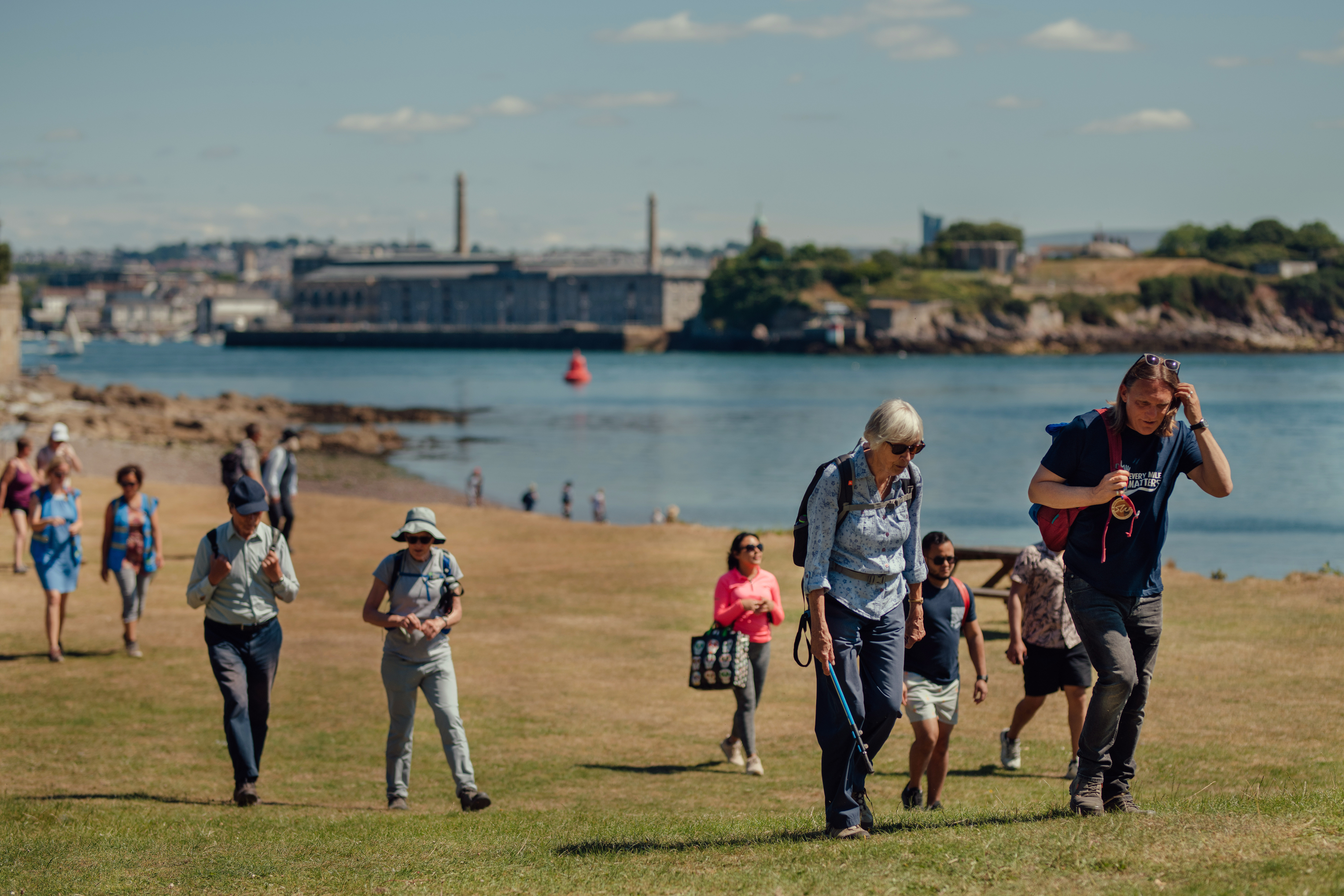
South West Coast Path Connectors “Saltlines Walk”, Kingsand, Cornwall
Photo: Dom Moore
In the UK for the past few decades, modern working practices and leisure activities have resulted in a disconnection between people and nature. However, the lockdowns during covid were a wakeup call to many – seeing the impact of not being able to access our green spaces. The challenge now is to ensure that we can take advantage of opportunities to reconnect to nature. An example is a shift towards hybrid working practices which allow us to take a walk in our lunchbreak. Our successful Coast Path Connectors, Couch to Coast and Connecting Actively to Nature projects have all focussed on helping people to connect to nature by walking along the Coast Path. We see this work as a core part of our charitable purpose and will continue to grow our capacity to deliver this important work as part of the Natural Health Service.
This article was originally written for the 2025 edition 111 of Trailblazing magazine
 The South West Coast Path